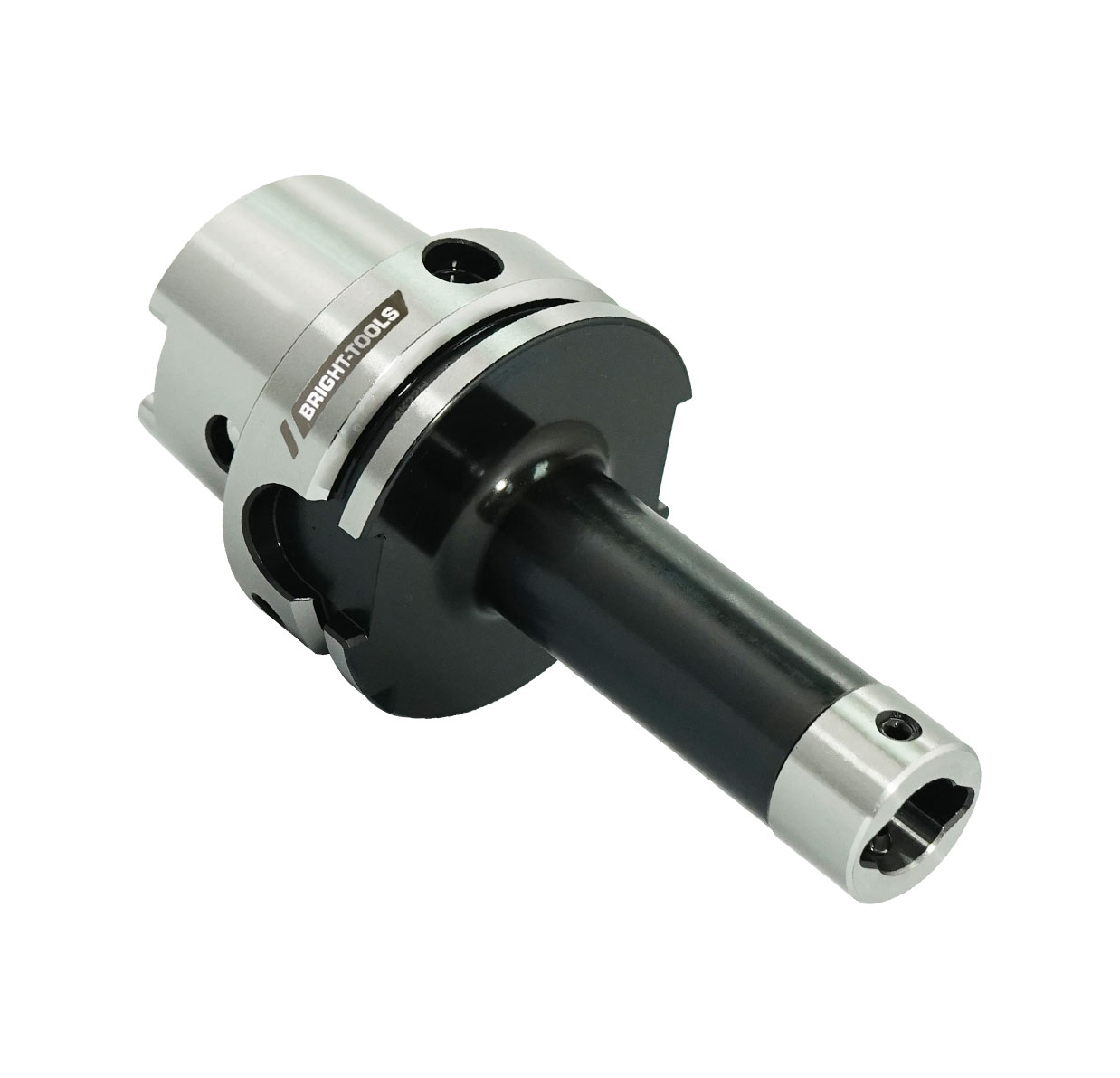
If you're choosing between HSK63A and HSK63F, the most important difference is their intended application. HSK63A tool holders are designed for CNC machining centers that require high rigidity, automatic tool changing, and compatibility with a wide range of machining operations. HSK63F, is primarily used on CNC routers for woodworking, plastics, composites, and light aluminum machining, where higher spindle speeds and lower tool holder weight are prioritized over maximum cutting forces.
Although both use the same HSK63 taper size, they are not directly interchangeable in every machine because of different flange dimensions, drive slots, and spindle interface standards. Selecting the correct HSK tool holder improves machining accuracy, spindle life, and production efficiency.
| Feature | HSK63A | HSK63F |
|---|---|---|
| Primary Application | Metal cutting | Woodworking & routing |
| Typical Machine | CNC machining center | CNC router |
| Rigidity | Higher | Moderate |
| Maximum Speed | High | Very high |
| Tool Change | Automatic | Automatic |
| Torque Capacity | Higher | Lower |
| Standard | ISO 12164 | ISO 12164 |
| Typical Materials | Steel, stainless steel, titanium | Wood, MDF, plastics, composites, aluminum |
Although both belong to the 63-size family, the spindle interface geometry differs, making each suitable for different industries.
HSK63A tool holders are the standard choice for metalworking machining centers.
Typical applications include:
Precision milling
Heavy roughing
High-feed machining
Mold manufacturing
Aerospace components
Automotive parts
Medical devices
Because HSK63A offers greater torque transmission, it performs exceptionally well during aggressive cutting operations.
Common holder types include:
ER collet chuck
Hydraulic chuck
Shrink fit holder
Milling chuck
Shell mill arbor
Face mill arbor
HSK63F (or HSK63 F) was specifically developed for CNC routers operating at very high spindle speeds.
Typical industries include:
Furniture manufacturing
Cabinet production
Door machining
Composite panels
Acrylic machining
Plastic fabrication
Lightweight aluminum processing
A typical HSK F63 tool holder emphasizes:
Reduced rotating mass
Excellent balance
High-speed stability
Lower spindle load
These characteristics allow CNC routers to operate continuously at spindle speeds exceeding 24,000 RPM.
Although the taper size appears identical, several structural differences prevent universal compatibility.
These include:
The drive key configuration differs between A-series and F-series holders.
The flange dimensions are optimized for different spindle systems.
HSK63A is designed for higher cutting forces.
HSK63F prioritizes rotational balance and high-speed operation.
Machine builders design spindles specifically for either A-series or F-series interfaces.
Installing the wrong holder may cause:
Poor clamping
Runout issues
Spindle damage
Tool change failure
Always verify the spindle specification before selecting an HSK tool holder.
Industries include:
Aerospace
Automotive
Mold & die
Precision engineering
Energy
Medical manufacturing
Typical machining:
Steel
Hardened steel
Stainless steel
Titanium
Cast iron
Industries include:
Furniture
Woodworking
Cabinet manufacturing
Sign making
Plastic machining
Composite processing
Typical materials:
MDF
Solid wood
Plywood
Acrylic
PVC
Aluminum profiles
When selecting an HSK 63 tool holder, consider the following factors:
Confirm whether your spindle requires:
HSK63A
HSK63F
Never assume compatibility based solely on taper size.
Choose according to your machining requirements:
ER collet
Hydraulic chuck
Shrink fit
Milling chuck
Side lock holder
For precision machining:
Low runout
High concentricity
Dynamic balancing
are critical.
Higher spindle speeds require holders balanced to G2.5 or better.
Heavy steel cutting generally favors HSK63A, while wood and composite routing are better suited to HSK63F.
Although HSK63A and HSK63F share the same nominal taper size, they are engineered for different machining environments. HSK63A tool holders deliver the rigidity and torque required for demanding metal-cutting applications on machining centers, while HSK63F is optimized for high-speed CNC routers used in woodworking, plastics, composites, and light aluminum processing. Choosing the correct HSK tool holder based on your spindle interface, machining material, and production requirements ensures maximum precision, tool life, and machine reliability.
For manufacturers seeking high-quality HSK holders, working with an experienced supplier that offers precision-ground tapers, strict balancing standards, and comprehensive quality inspection can significantly improve machining performance and reduce long-term operating costs.
Generally, no. Although the taper size is similar, the flange design, drive slots, and spindle interface differ. Using the incorrect holder may result in improper clamping, excessive runout, or spindle damage.
The "F" designates an HSK interface designed primarily for high-speed CNC routing applications, where lighter rotating mass and excellent balance are prioritized.
HSK63A offers higher rigidity and torque transmission, making it more suitable for heavy metal cutting and demanding milling operations.
Yes, but mainly for light-duty aluminum machining. It is not intended for heavy steel or high-torque milling applications typically performed on machining centers.
The correct size depends on your spindle interface, machine power, spindle speed, tool diameter, and cutting application. Among standard HSK tool holder sizes, HSK63 is the most common for general machining, while HSK100A is preferred for large, heavy-duty machining centers.
HSK provides dual-contact clamping between the taper and flange, resulting in higher rigidity, better repeatability, improved dynamic balance, and greater accuracy at high spindle speeds compared with traditional BT systems.
 English
  日本語
日本語  한국어
한국어  Deutsch
  Español
  italiano
  русский
  tiếng việt
  Türkçe
  português
  فارسی
فارسی  zh-CN
zh-CN